Research Overview
My research program develops statistical methodology motivated by real problems in biomedical and public health science. The methodological strands — two-component mixture models, classification for high-dimensional data, longitudinal and correlated data analysis, and hypothesis testing — are tightly linked to substantive applications in early detection of cancer and Alzheimer's Disease, cardiometabolic outcomes after liver transplant, environmental exposure, dental caries, and mental health.
I collaborate closely with epidemiologists, clinicians, virologists, nutritionists, and psychologists, and my methodological work is regularly driven by problems encountered in those collaborations. I am also fortunate to advise MS, PhD, and MPH students whose thesis and capstone work often becomes the seed for our next methodological paper.
Recent Research Highlight
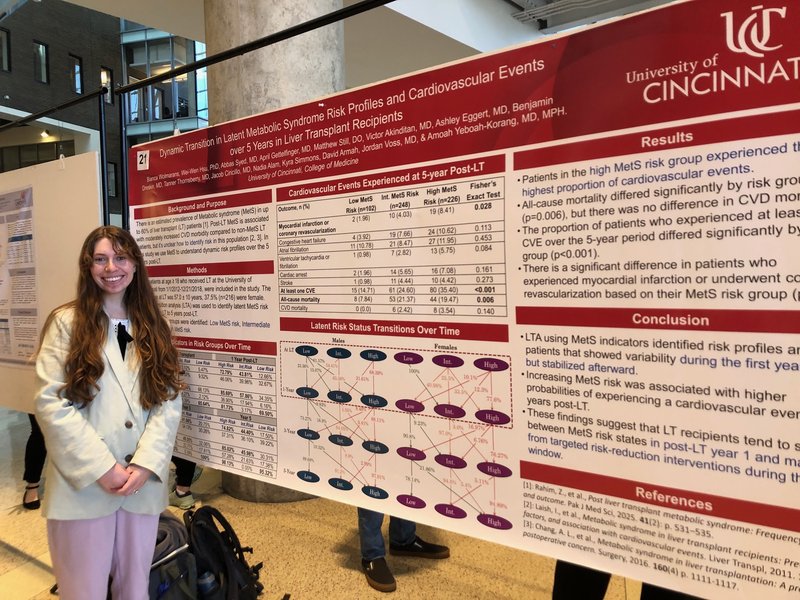
Dynamic Transitions in Latent Metabolic Syndrome Risk Profiles after Liver Transplantation
In this recent collaboration with UC's transplant surgery group, we used latent transition analysis to characterize how metabolic syndrome risk evolves in adult liver transplant recipients over the first five years post-transplant, and to quantify the association between these latent trajectories and incident cardiovascular events. The work brings together two strands of my methodological research — longitudinal/correlated-data modeling and classification for clinically meaningful subgroups — and illustrates how latent-variable methods can inform post-transplant risk-stratification and the timing of cardiovascular risk-reduction interventions.
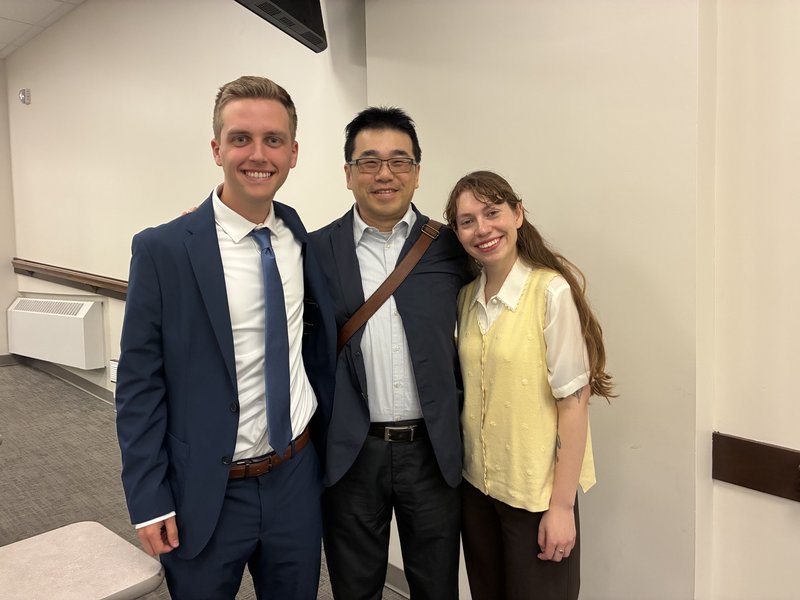
Lead student: Bianca Wolmarans, MPH-Biostatistics (UC, 2025–2026). Manuscript in preparation; thesis available on request.
Methodological Themes
Two-Component Mixture Models
Two-component mixture models arise naturally when a population can be decomposed into a "susceptible" subgroup and an "immune" or zero-count subgroup — for example, in cure-rate survival analysis or zero-inflated count data. My work develops score-type, supremum, and quasi-score tests for homogeneity in such mixtures, focusing on settings where the heterogeneity parameter lies on the boundary of the parameter space and standard likelihood theory breaks down. Recent extensions address generalized additive structures, model misspecification, and stratified populations.
Representative papers:
Classification for High-Dimensional Data
Modern biomarker and -omics studies routinely produce datasets with far more features than subjects, and with severe class imbalance between cases and controls. My research develops classification and screening methods that remain reliable in these regimes — including covariate-adjusted classifiers for multiple biomarkers, methods tailored to imbalanced disease-screening data, and approaches that account for measurement-scale heterogeneity across biomarkers. The motivating applications are early cancer detection and early identification of Alzheimer's Disease.
Representative papers:
Longitudinal and Correlated Data Analysis
Many of the public-health studies I collaborate on produce repeated measures or clustered outcomes — from longitudinal alcohol-use trajectories in college students, to dental-caries counts within mouths, to metabolic syndrome status across post-transplant follow-up, to mosquito-borne virus shedding measured across timepoints. I develop marginal mean models, latent-transition models, and hierarchical-model diagnostics that are robust to common departures from standard assumptions, with particular attention to count outcomes containing excess zeros and to nonparametric scanning over continuous covariates.
Representative papers:
Hypothesis Testing under Non-Standard Conditions
A common thread across my methodological work is hypothesis testing when standard regularity conditions fail — e.g., when a parameter lies on the boundary of its space, when the test is supremum-type over a nuisance space, or when the null model is misspecified. I develop adjusted supremum score-type statistics, robust score tests, and Wald-type tests for zero inflation/deflation that retain valid Type-I error and good power under these difficulties.
Representative papers:
Application Areas
Cancer Research — Early Detection and Biomarker Discovery
I work with urologists, oncologists, and molecular biologists on biomarker discovery and early detection — from circulating methylated DNA panels for early breast cancer, to focal ablation outcomes in localized prostate cancer, to systematic reviews of salvage prostatectomy. My role spans study design, classifier development for high-dimensional biomarker data, and statistical analysis of clinical-trial outcomes.
Selected collaborations:
Prostate Cancer Research
I collaborate extensively with the urologic oncology group on the diagnosis, treatment, and surveillance of localized prostate cancer. This work includes focal ablation and cryoablation outcomes, prebiopsy and post-ablation MRI (mpMRI) combined with PSA measures for detecting clinically significant disease, and systematic reviews and meta-analyses of salvage and surgical approaches. My role spans study design, diagnostic-accuracy and survival analysis, and network meta-analysis of clinical outcomes.
Selected collaborations:
Transplant and Cardiometabolic Outcomes
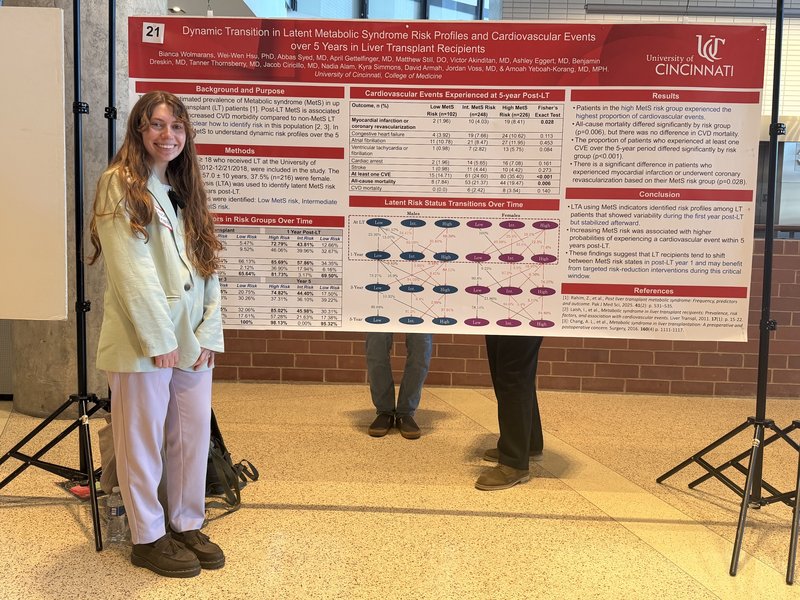
A newer collaborative direction focuses on post-transplant outcomes — especially the trajectory of metabolic syndrome and cardiovascular risk in adult liver transplant recipients. We use latent-transition and longitudinal classification methods to identify subgroups of recipients whose risk profile evolves differently over the first five years post-transplant, and to inform when and for whom targeted risk-reduction interventions are most likely to help.
Recent student work:
Geriatric Research — Alzheimer's Disease
I am interested in latent-transition and classification approaches for monitoring and early detection of Alzheimer's Disease, including in special populations such as military veterans. Student-led capstone work has explored both methodological aspects (latent transition models) and applied questions (early detection within at-risk cohorts).
Selected work:
Environmental Exposure Research
With collaborators in environmental health, I study the long-term consequences of chemical and residential exposures — including in-utero PCB exposure and decreased fecundability in the Michigan female fisheaters cohort, and residential proximity and quality-of-life outcomes in the Fernald cohort. The methodological challenges include modeling cumulative exposure, accounting for missingness, and analyzing health-related quality-of-life endpoints.
Selected collaborations:
Dental Caries Research
Dental caries data are a canonical example of correlated, zero-inflated count outcomes — multiple surfaces per tooth, multiple teeth per mouth, and many surfaces with zero caries. My work develops Wald and score tests for zero inflation/deflation in this clustered setting, providing diagnostic tools for choosing among standard Poisson, zero-inflated, and zero-deflated models.
Selected work:
Mental Health Research
I collaborate with psychologists and adolescent-health researchers on longitudinal studies of substance use, racial discrimination, and parental influence among adolescents and young adults. The methodological focus is on longitudinal trajectories, latent-class characterizations of risk patterns, and the interplay between protective factors and outcomes over time.
Selected collaborations:
Update: 9/22/2026