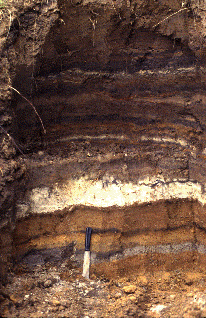
This is Karymsky Volcano, located in the western Pacific on the Kamchatka peninsula. The following is a report on the January, 1996, eruption of Karymsky.
Friday, January 5, 1996 3:30 PM AST
KARYMSKY VOLCANO,
Kamchatka Peninsula, Russia
54o03' N 159o27' E
Summit elevation 1536 m (5069 feet)
The explosive eruption which began January 1 near Karymsky volcano on the Kamchatka Peninsula continues as of today. The eruption began between 0500-0700 UTC, Julian day 001 in the north end of Karymsky Lake about 5 km south of Karymsky volcano proper. The initial stage of the eruption was apparently phreatomagmatic in character; Russian aviation sources reported an ash plume to 7,000 meters (23,000 feet) above sea level at approximately 2330 UTC, Julian day 001. Based on a satellite image at 0200 UTC, the plume extended at least 200 km (120 miles) southeast and south of the volcano. When the volcano was visited on January 3, activity had shifted to Karymsky volcano where a new crater had formed on the south-southwest side of the cone adjacent to the old summit crater. The new crater is now over twice the size of the old crater. A thick black ash plume has been observed the past two days erupting explosively from the new crater to altitudes ranging from 2,400 m (8,000 feet) ASL to 5,500 m (18,000 feet) ASL. Seismicity as of 2030 UTC today suggests this activity continues with explosions every 1-3 minutes. Ash fall has been widespread throughout Karymsky caldera and for a considerable area to the east and north.
Karymsky Lake, which occupies a late Pleistocene caldera and is about 5 km in diameter, continues to be yellow-gray in color and mostly covered by steam and vapor. Karymsky River drains the lake and flows between the lake and the volcano. The river is now blocked from the lake and has a considerable diminished rate of flow; a new beach with numerous fumaroles marks the former source of the river.
Karymsky volcano is one of the more active volcanoes in Kamchatka having erupted over 20 times in the past 200 years although it has been relatively quiet since 1982 following a decade of frequent eruptive activity. Periods of seismic unrest have occurred several times in the past 12 months and the volcano emits a continuous steam plume. The volcano is capable of explosive eruptions which can send ash to over 10 km (33,000 feet ASL) and continue sporadically for days or weeks; short lava flows are also a possibility. The volcano is located in a remote part of the Kamchatka Peninsula about 110 km (70 miles) northwest of Petropavlovsk-Kamchatsky and no towns or villages are threatened. The chief hazard at this time would appear to be encounters between airborne volcanic ash and aircraft.