To start with if, the resistor is wire-wound or a spiral in shape as in some power resistors, its equivalent inductance will immediately shadow the resistance and will behave as a indcutive reactance as the frequency is increased.
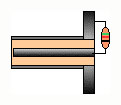
We may use a thin film or carbon resistor. In this case, as we increase the frequency, the inductnce associated with the leads of the resistor connecting to the adaptor will become important but at a higher frequency. As the frequency increases, it is possible that fields may radiate from the opening of the adaptor and thus introduce additional loss. This may (coupled with the resistor and the resistor series inductance) represent a complex load at the termination rather than a purely resistive load.
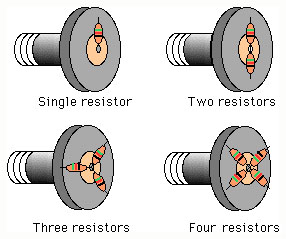
To reduce the radiation problem, one can use two, three or four resistors in parallel by increasing the resistance values so that the parallel combination is still 50 W as shown in the figure below.
In this case, one may think that the resistors will block the opening and reduce the radiation loss. There may be improvement of the laod but still the inductances associated with the leads of the resistors and small leakage from the openings will still not provide a purely reistive load at higher frequencies especailly as we aproach microwave and millimeter wavelengths.
The aim of the Experiment #1 is to verify these expectations.
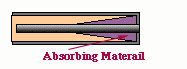
An actual microwave coaxial load is shown below. The material bewteen the inner and outer conductors is an absorbing element. As the wave is incident on this material, microwave power is absorbed. It is tapered so that the absorption is gradual and reflections are minimized. If all the incident power is absorbed and nothing (or very little) is reflected back, it satisfies the condition of a microwave load.