ECECS
349
Measurements Laboratory
Experiment #5
Oscilloscope as an Impedance
Meter
OBJECTIVE:
To
measure complex impedance using an oscilloscope as an impedance meter. Figure 1
shows the typical set up for measuring impedance. The aim is to measure the
current I into the circuit and the voltage V across the input terminals of the
circuit at a given frequency. Then the impedance is given by Z=V/I. Note that
in general all these parameters may be complex.
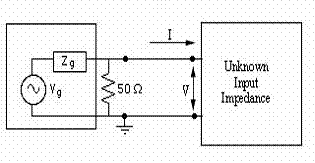
Figure 1
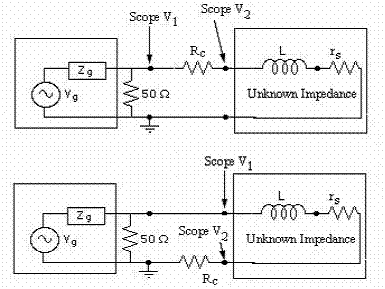
Figure 2.
1)
Pick an arbitrary commercial
inductance. Measure the inductance and the series resistance by an LCR meter at
100 Hz, 10 KHz, and 1 MHz. Pick a current monitoring resistor Rc and
measure its exact value with a multimeter. Connect the circuit shown in Figure
2. Set the signal generator to a sinusoidal signal at a frequency of 100
Hz. Measure V1 and V2
(the magnitude and phase) and if necessary the difference of the two voltages.
Switch the positions of the unknown impedance and the series resistance Rc.
Repeat the voltage and phase measurements. From the measured data, calculate
the L and rs.
Repeat
the experiments at 1 KHz, 10 KHz, 100 KHz and 1 MHz. For each frequency, calculate
the inductance L and the series resistance rs of the inductance from
the measurements. Compare these with the values that you measured using the LCZ
meter. Plot the inductance and series resistance values on the graph at each
frequency for each of the data set.
2) Switch
the scope setting to X-Y. Observe the Lissajous
figure. From the figure can you determine the unknown impedance? Compare with
measured value in (1).
3)
Take an inductance, two capacitors, one inductor and 2 resistors. Measure their
pertinent values with an LCR meter at only 10 KHz. Make an unknown AC circuit
by connecting these five elements in an arbitrary manner (series and parallel
combinations). This will be referred to as Unknown Circuit (UC).
Using the set up shown in Figure 1,
measure the input impedance of the UC circuit at 1 KHz, 10 KHz, 100 KHz and 1
MHz. Calculate Zin = Rin + jXin at each
frequency.
4) Switch
the scope setting to X-Y. Observe the Lissajous
figure. From the figure can you determine the unknown impedance? Compare with
measured value in (3).
QUESTIONS:
1)
From the set of
measurements of the inductance, do you observe differences in the inductor and
series resistor values at different frequencies? If so explain why?
2)
How do these compare
with the values measured by LCR meter?
3)
For the case of the UC,
calculate the input impedance of the circuit using the AC circuit equations and
compare with the measured values. Explain the differences.
4)
Plot the measured
input impedance of UC in polar coordinates (magnitude and phase) as a function
of frequency.
5)
Using PSPICE, simulate
your UC and compare the simulated results with the measured values. What is the
percentage of error between the measured and simulated values? Plot the percentage
of errors as a function of frequency. Explain the sources of error.
Helpful
URL