UNIVERSITY OF CINCINNATI
ECE 349
Measurements Laboratory
Experiment #2
Voltage and Current Measurements
OBJECTIVE:
The purpose of this lab is to learn how to make correct and accurate voltage and current measurements. At low frequencies the tools are voltmeters, ammeters, multimeters and oscilloscopes. At higher frequencies, the tools are Vector Voltmeters and Vector Network Analyzers (VNA). There are important parameters of all these instruments and if they are not carefully taken into account, measurement errors are introduced. The connecting wires between the instrument and the source to be measured play a crucial role in these measurements. Various parameters will be considered in detail here in order to introduce the critical parameters in measuring instruments. To introduce these concepts, an oscilloscope will be used to demonstrate the importance of many of these parameters.
EXPERIMENTS:
- Connecting
wires and cables:
1) Connect two wires between the input of the scope and output of the function generator. Apply a repetitive square wave and vary the pulse repetition rate from low values to up to 15 MHz. Observe the waveform on the scope so that you can see the rise and fall times of the pulses. Copy the images at 100Hz, 10 KHz, 1 MHz and 15 MHz repetition rates. Explain what you observe. At higher frequencies, move the connecting wires around, observe what happens.
2) Replace the wires with a coaxial cable and connect directly the coaxial cable between the signal generator and the scope input and repeat the measurements in A.1. Record your data (at the same frequencies as above). Explain what differences that you observe compared to the two wire system.
3) Use the coaxial line in A.2. Open circuiting one end, measure the capacitance of the line from the other end using the LCR meter. Record the C value. Next, short circuit one end, end measure the inductance of the line from the other end using the LCR meter. Record the L value. Calculate
 Is this close to 50W?
4)
This time use the same coaxial cable and
connect a 50W resistor across the input terminals of the scope.
Repeat A.1 and explain the changes.
Can you use the scope with a 50W resistor connected to its input for measuring voltages across arbitrary resistors in a given circuit? Explain.
- Scope
Probe
An
oscilloscope has equivalent input impedance with a high resistor (1 MW) in parallel with a small capacitance (13-20 pF) at its input
terminals. In order to eliminate the effects of the input impedance of the
scope on the voltage measurements, a probe with compensating impedance is used.
Figure below shows the equivalent circuit of the scope input impedance, coaxial
cable capacitance and the compensation network. (see the Supplementary Notes 1)
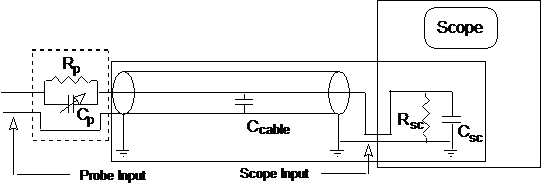
Here: Rsc=1 MW, Csc=13 pF, Ccable=maybe
between 100-150 pF depending on the length, Rp= 9MW (for a 10:1 probe) and Cp depends on the compensation.
1) Using the LCR meter, measure the capacitance of the probe without shorting its input end. Record this value. Using this value and the given values of Rs and Cs above, calculate Cp.
2) Connect the probe to the calibration output at the scope and observe the calibration square pulse by varying the probe capacitance so that over and under compensations are recorded.
3) Connect a 50W resistor across the signal generator output and measure the rise and fall times of the repetitive pulses as in A.1. Make sure that the probe is properly calibrated. Explain your observations.
4) This time change the signal generator to a sinusoidal signal and record the magnitude of the signal against the signal generator output. What happens to the signal magnitude at higher frequencies?
5) At home: Simulate the probe circuit using PSPICE and the correct values of Rs and Cs above. Choose your input rise and fall times to be picoseconds and observe the output voltage. Vary the Capacitor Cp so that it is below and above the compensated values and record the output waveform for each of these capacitor values. Do they look similar to the observations you made when you were calibrating the probe?
6) Is the equivalent circuit above applicable at very high frequencies? Can you use the probe for measuring very high frequencies into the GHz range if your scope were to respond to these frequencies?
- Current
measurements.
Set-up the circuit given below. Use a DC voltage (10V) at the input. Pick R1=1 KW and R2= 2 kW (find nearest values available, measure their exact values by a Multimeter).
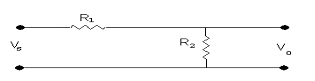
1) Measure the voltage across and the current through R2 using the oscilloscope.
2) Measure the voltage across and the current through R1 using the oscilloscope. Explain how you did this?
3) If both R1 and R2 were changed to 1 MW each, repeat measurements C.1 and C.2. Are the results accurate? Are there any errors introduced in these measurements? If so, calculate the percentage of error.
4) Change the probe setting to 1:1 and repeat C.3.
5) If you were to insert a small resistor (i.e. around 100W) in series with R2 near the ground end, can you now measure the current more accurately? What is the error introduced by this technique?
6) Change the source to a sinusoidal voltage and repeat
C.1 through C.4. Does the same limitation apply to the sinusoidal measurements?
Explain.

A current sensor chip:
http://www.allegromicro.com/en/Products/Part_Numbers/0712/index.asp